BORIS ANDREWS

Postdoctoral Research Associate, University of Oxford (he / him)
CONSERVATIVE AND DISSIPATIVE DISCRETISATIONS OF MULTI-CONSERVATIVE ODEs AND GENERIC SYSTEMS
Boris Andrews | Patrick Farrell
28.NOV.2025 (arXiv) | In review (CAMWA)
[…] we present two novel contributions: (i) an arbitrary-order time discretisation for general conservative ordinary differential equations that conserves all known invariants and (ii) an energy-conserving and entropy-dissipating scheme for […] differential equations written in the GENERIC format […]. We illustrate the advantages of our approximations with numerical examples of the Kepler and Kovalevskaya problems, a combustion engine model, and the Benjamin–Bona–Mahony equation.
In this work we present two novel contributions: (i) an arbitrary-order time discretisation for general conservative ordinary differential equations that conserves all known invariants and (ii) an energy-conserving and entropy-dissipating scheme for both ordinary and partial differential equations written in the GENERIC format, a superset of Poisson and gradient-descent systems. In both cases the underlying strategy is the same: the systematic introduction of auxiliary variables, allowing for the replication at the discrete level of the proofs of conservation or dissipation. We illustrate the advantages of our approximations with numerical examples of the Kepler and Kovalevskaya problems, a combustion engine model, and the Benjamin-Bona-Mahony equation.
You can view this preprint as the “spiritual successor” to my previous work with Patrick Farrell. In Part 1, we showed how one can jointly employ auxiliary variables and finite elements in time to preserve multiple, general conservation laws and dissipation inequalities in PDE discretisations. This was exciting work, as classical approaches for constructing timestepping schemes (such as Runge–Kutta methods and symplectic integrators) typically fail to preserve the behaviour of non-quadratic invariants, and other bespoke structure-preserving integrator were typically limited to a maximum of one preserved quantity of interest.
Now in Part 2, we show just how powerful this idea can be, with two related examples…
Multi-conservative ODEs
Many physical systems have many invariants.
I’ll fix ideas with somewhat of a canonical example (at least, one we consider in the manuscript): the Kepler problem, a simple 2-body gravitional system, e.g. for a planet orbiting a star. Of course energy is conserved, that’s always the case. But there’s also the angular momentum, which encodes the speed of the orbit. And then (less famously) there’s a final conserved invariant called the Runge-Lenz (RL) vector, which encodes the angle of the orbit; conservation of the RL vector is what prevents a planet’s orbit from precessing.
Implicit midpoint would here conserve energy and angular momentum—both are quadratic—but it won’t conserve the non-polynomial RL vector. Naturally then (despite it being commonplace and well loved in the literature) such simulations exhibit some pretty shocking unphysical precession:
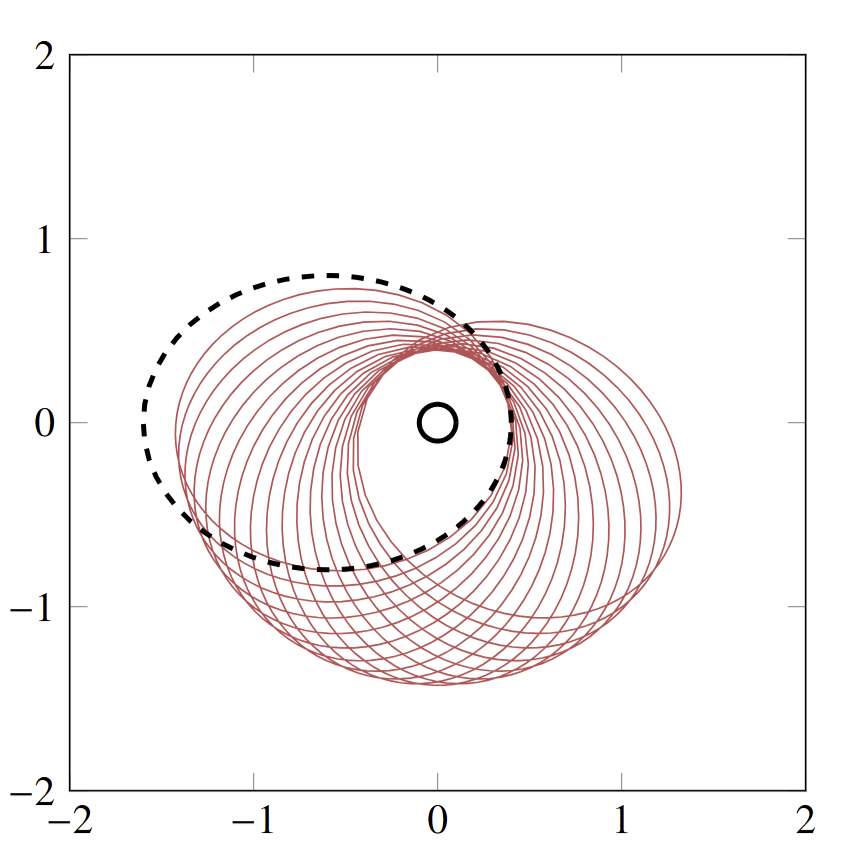
In this manuscript, Patrick Farrell and I employ our auxiliary variable framework to construct an integrator for general ODE systems with multiple invariants that conserves every known invariant. Here it is on the same Kepler problem:

Simulations of the Kepler problem and the Kovalevskaya top (detailed in the manuscript) show some very substantial improvements in the quality of the numerical solutions.
GENERIC systems
The GENERIC formalism is somewhat of a “grand unified theory” for non-equilibrium thermodynamics. It describes systems that simultaneously exhibit both:
- reversible dynamics (like Hamiltonian mechanics) with a conserved energy…
- …and irreversible dynamics (like friction or heat diffusion) with a generated entropy.
It’s like an extension of Hamiltonian mechanics that doesn’t just incorporate the First Law of Thermodynamics (energy conservation), but the Second Law (entropy generation) too.
As the name suggests, this is extremely general. Examples of such systems include:
- the compressible Navier–Stokes equations;
- the Boltzmann equation;
- pretty much any irreversible thermodynamic system.
Simulating these accurately is tricky. Despite being a simple modification to a Hamiltonian system, the introduced dissipative component means symplectic integrators can really fail quite badly.
In the manuscript, for example, we consider a simple dissipative thermodynamic engine, that should in theory slow to a halt. Using implicit midpoint (red) however, we find the numerical solution can perform as bad as to accelerate faster and faster and FASTER, until the solver fails (and presumably the engine explodes).
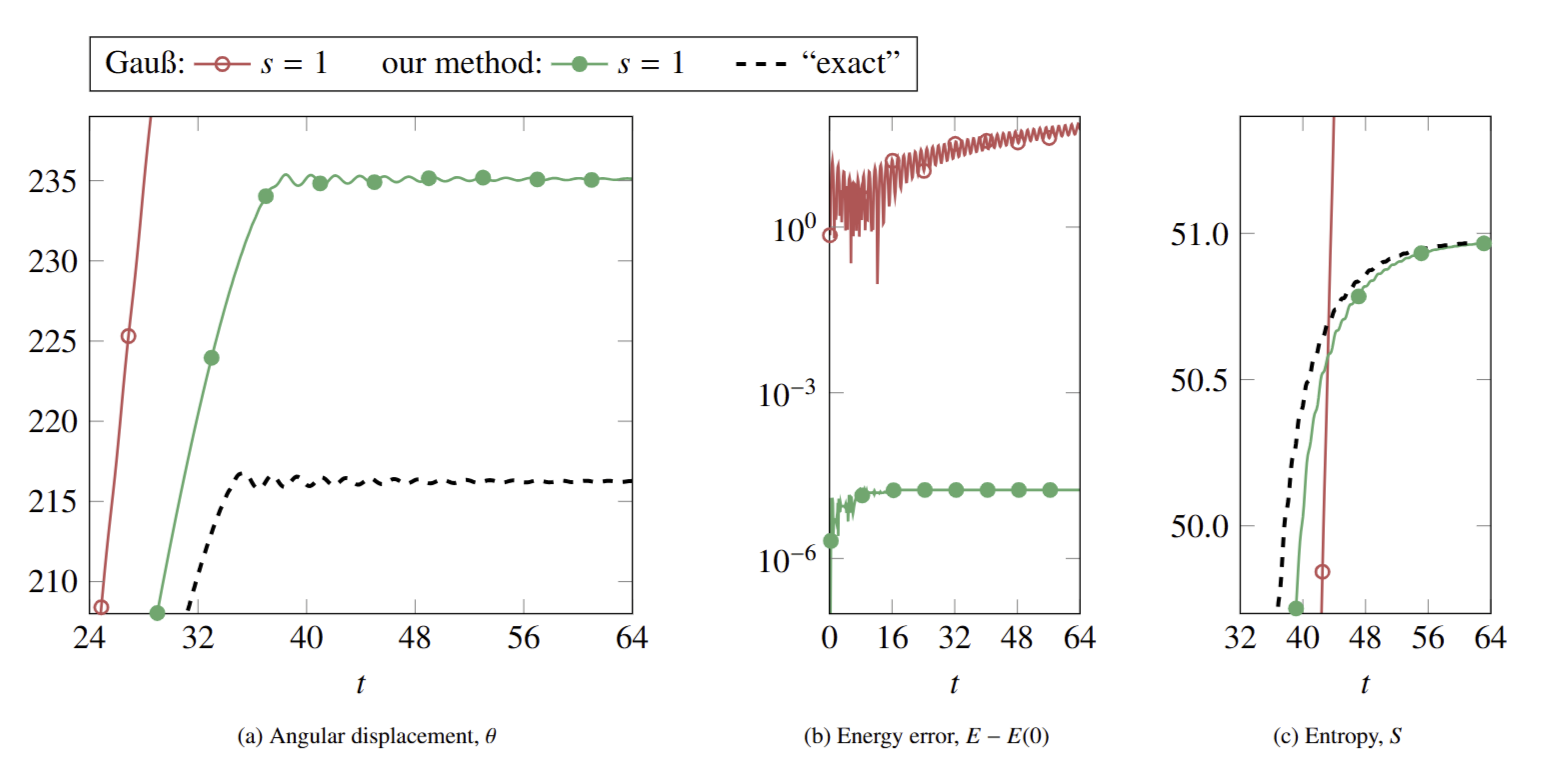
We apply the framework from our previous paper to construct numerical integrators that preserve both the conservative and dissipative structures. As such, we have a general way to construct structure-preserving integrators for any of the above ODE and PDE systems. You can see the results with our comparable 1-stage scheme (green) in the figure above; nice and dissipative! For a PDE example, the manuscript presents an integrator for the Boltzmann equation that preserves both the conservation of energy and generation of entropy.
Preserving these properties is crucial for accurately capturing the dynamics of these systems.
We would both gladly discuss it further!
VIDEOS
Check out Patrick’s Langtangen Seminar (22.APR.2025) at Simula below:
His earlier ACM Colloquium (13.NOV.2024) at the University of Edinburgh and Heriot-Watt University can be found here.
RELATED WORKS
As stated above, the construction of both the schemes in this manuscript employs the framework presented in my earlier work with Patrick Farrell, on conservative and dissipative finite element integrators.
RELATED OPEN PROBLEMS
TALKS
2026
- SciCADE, University of Edinburgh
- ECCOMAS WCCM, Munich
- Invited Seminar, Chinese Academy of Sciences
2025
- Biennial Numerical Analysis Conference, University of Strathclyde
- Numerical Mathematics & Scientific Computing Seminar, Rice University
- SIAM CSE, Fort Worth, Texas
- Scientific Computing Seminar, Brown Unversity
2024
- External ("tiny desk") Seminar, Rice University
- Computing Division Technical Meeting, UKAEA
- Firedrake User Meeting, University of Oxford
- PDEsoft, University of Cambridge
- Finite Element Fair, University College London (UCL)
- Exploiting Algebraic and Geometric Structure in Time-integration Methods workshop, University of Pisa
- UKAEA PhD Student Engagement Day, UKAEA
- Junior Applied Mathematics Seminar, University of Warwick
2023
- ICIAM, Waseda University
- Numerical Analysis Group Internal Seminar, University of Oxford
- Junior Applied Mathematics Seminar, University of Oxford
- Met Office Presentation, University of Oxford